
Just came home from an unforgettable day of shooting at the Ladies Day at the Range hosted at Royalston Fish and Game in Royalston, Massachusetts and put together by Dan and Missi Eaton of Firearms Safety Training Company and Claudia Stewart who is an NRA certified firearms instructor as well as all around KICK ASS woman (as is Missi Eaton OF COURSE!).
The day started off with a flawlessly put together safety training/orientation of guns and the sport of shooting. After the thorough safety training, participants were sent to various stations spread about the grounds of Royalston F&G.
The lovely lady participants were trained in pistols, rifles, shotguns, archery, and fly fishing - yes, I said fly fishing. You very own Le Femme tried her hand a bit of relaxing and slow paced fly fishing.... only to be itching for more GUNS!
Each station had ample instructors flowed at a perfect pace and with no pressure or high expectations.
THEN... came the Pies de Resistance... my first shot with a Barrett .50 Cal. Now for those of you who are new to guns, all you need to know is the Barrett .50 Cal is one BAD ASS gun. Wow! No woman who decides shooting is for her, should go without shooting this AMAZING piece of equipment if ever given the chance. It is guaranteed to give what my husband and I affectionately call a "perma-grin"
Below is a video kindly taken by Dan of my first shot with his Barrett .50 Cal - ENJOY!
All in all and absolutely perfect day!!!


- The women's rifle team, Abigail Adams House, 1928.
The largely ignored women pioneers of the early 20th century studied such subjects as pomology, floriculture, entomology, and dairy. They boarded with local residents or lived atop Draper Hall and were instructed to “wear skirts or long coats over bloomers or riding breeches when in trolleys or in town.” They were subject to teasing, strict curfews, and were unwelcome in many campus clubs. Still, they excelled academically. The first two women grads were both Phi Beta Kappa, and one early female student won $50 and a ton of fertilizer for her agricultural smarts. Women formed their own groups, such as a choral society and the first campus sorority, Delta Phi Gamma.
Kenyon Butterfield, who became president of MAC in 1906, was the first campus leader to give the women students serious consideration. He hired Edna Skinner to advance the cause of women’s education. From 1919 to 1946, she was the college’s chief voice for women, and dean of the new school of home economics. She oversaw the 1920 opening of the first dorm for women, Abigail Adams House (known as “The Abbey”), and steadfastly pressed for increased enrollment, wider opportunities, and better facilities for women.
Helen Curtis Cole succeeded Skinner as dean of women and battled educational inequities for 28 years. She fought against higher admission standards applied to women and pushed to allow women to become engineering, business, pre-med, and pre-vet majors.
The years of the women’s liberation movement saw the first coed dorm on campus (Greenough in 1970) and the birth of three vital and enduring UMass Amherst entities: the Everywoman’s Center, the Women’s Studies program, and the Status of Women Council.
After a century of growth, women are no longer hidden in the UMass Amherst garden: The entering class of 2013 is 52 percent female, and there are about 450 full-time female instructional faculty (more than 200 with tenure). However, “There are still a lot of things to do,” says Kathleen Davis, associate professor in the School of Education and co-chair of the Status of Women Council. Today’s council looks to improve recruitment of women faculty and staff, promotion and salaries, the granting of tenure, the establishment of daycare centers, sexual harassment policy, the admission of undergraduate and graduate women students, the granting of financial aid, and more.
Says Davis, “We are alive and well and still fighting for gender equity.”



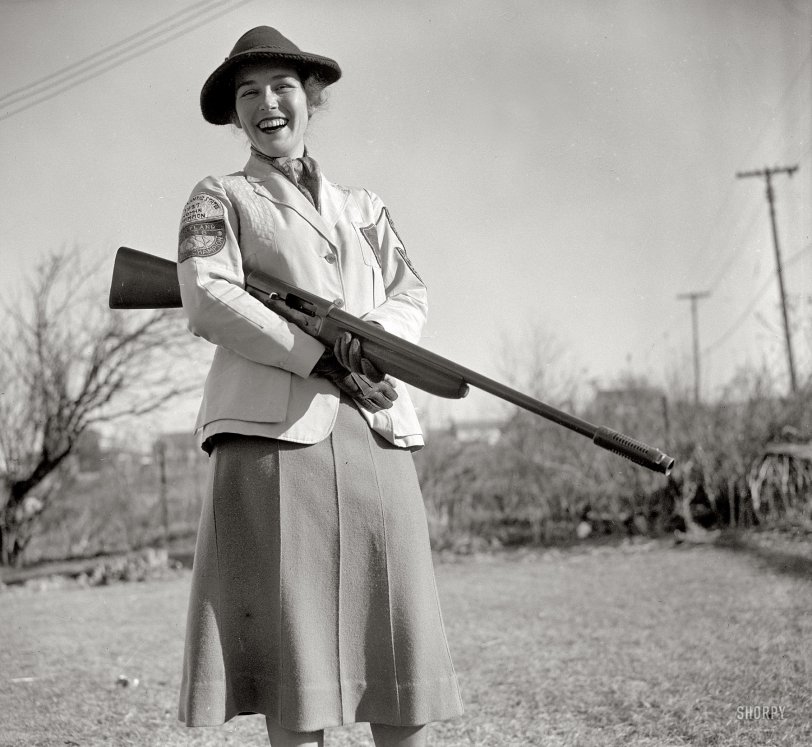
 This was considered the "wrong" way to hold a rifle.
